Approach 1:
You are given two non-empty linked lists representing two non-negative integers. The digits are stored in reverse order, and each of their nodes contains a single digit. Add the two numbers and return the sum as a linked list.
You may assume the two numbers do not contain any leading zero, except the number 0 itself.
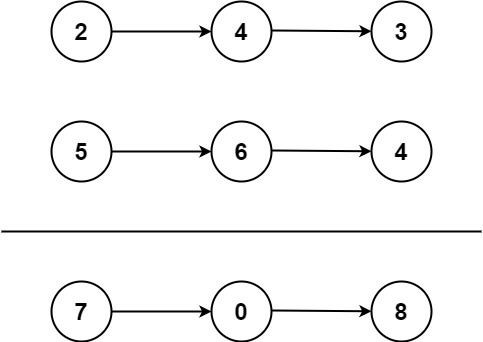
Input: l1 = [2,4,3], l2 = [5,6,4]
Output: [7,0,8]
Explanation: 342 + 465 = 807.
Intuition
在构造一个linked list时,一般会加一个dummy header node, 保证boundary nodes和internal nodes有一样的处理方法
这一题初始条件位carry = 0
每一个时步要计算:
- l1 and l2的当前值, None则说明没有node, 则为0
- 计算val = l1 + l2, 是一个0 - 18的数字
- 计算进位carry = val//10 and 余数val = val%10
Code
# Definition for singly-linked list.
# class ListNode:
#     def __init__(self, val=0, next=None):
#         self.val = val
#         self.next = next
class Solution:
    def addTwoNumbers(self, l1: Optional[ListNode], l2: Optional[ListNode]) -> Optional[ListNode]:

        dummy = ListNode()
        curr = dummy

        carry = 0

        while l1 or l2 or carry:
            val_1 = l1.val if l1 else 0
            val_2 = l2.val if l2 else 0

            val = val_1 + val_2 + carry
            carry = val//10
            val = val%10

            curr.next = ListNode(val)
            curr = curr.next

            l1 = l1.next if l1 else None
            l2 = l2.next if l2 else None

        return dummy.next