Problem
Given the head of a linked list, reverse the nodes of the list k at a time, and return the modified list.
k is a positive integer and is less than or equal to the length of the linked list. If the number of nodes is not a multiple of k then left-out nodes, in the end, should remain as it is.
You may not alter the values in the list's nodes, only nodes themselves may be changed.
Example 1:
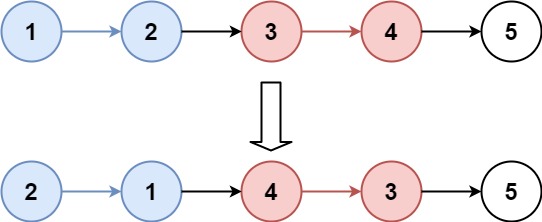
Input: head = [1,2,3,4,5], k = 2
Output: [2,1,4,3,5]
Example 2:
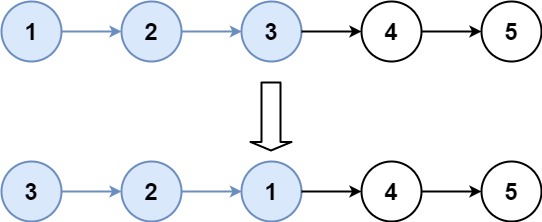
Input: head = [1,2,3,4,5], k = 3
Output: [3,2,1,4,5]
Constraints:
- The number of nodes in the list is
n. 1 <= k <= n <= 50000 <= Node.val <= 1000
Intuition
The problem is asking for reverse sub-linked list, in sub-groups. The first question is to determine the number of sub-groups. My train of thought is illustrated in the image below

To determine the length of linked list, we do this
# step1: traver to get the length
dummy = ListNode(None,head)

ll_length = 0

curr = head
while curr:
    ll_length += 1
    curr = curr.next
After we determine the linked list length, we could easier get the number of groups and number of left out nodes
# step2: compute necessary infos
num_of_groups = ll_length//k
num_of_left_out_nodes = ll_length%k
Since we need to reverse for every sub-group, there must exist a nested loop structure,
# iterate among all groups
for _ in range(num_of_groups):
            # iterate within the group
            for i in range(k):
Now, after we reverse our linked list classically, we need to do two things: - connect dummy node with node 2 - connect node 1 with node 3

If we use more generalized form, for connecting and stitching group i, we need to
- connect the tail node of group i-1 with the starting node after reversal
- connect the starting node of group i before traversal.
Summarize them and their updating strategy in the table
|variable name|description|initial condition|updating strategy|
|-|-|-|-|
|last_group_tail_node|-|dummy|start_node|
|start_node|-|head|curr|
Note: 原来的
start_node在reverse之后,变成了tail node of the sub-group.
Code
# Definition for singly-linked list.
# class ListNode:
#     def __init__(self, val=0, next=None):
#         self.val = val
#         self.next = next
class Solution:
    def reverseKGroup(self, head: Optional[ListNode], k: int) -> Optional[ListNode]:
        # step1: traver to get the length
        dummy = ListNode(None,head)

        ll_length = 0

        curr = head
        while curr:
            ll_length += 1
            curr = curr.next
        # step2: compute necessary infos
        num_of_groups = ll_length//k
        num_of_left_out_nodes = ll_length%k

        # step3:
        curr = head
        last_group_tail_node = dummy
        start_node = head
        for _ in range(num_of_groups):
            prev = None
            for i in range(k):
                temp = curr.next
                curr.next = prev
                prev = curr
                curr = temp

            last_group_tail_node.next = prev
            last_group_tail_node = start_node
            start_node.next = curr
            start_node = curr

        return dummy.next